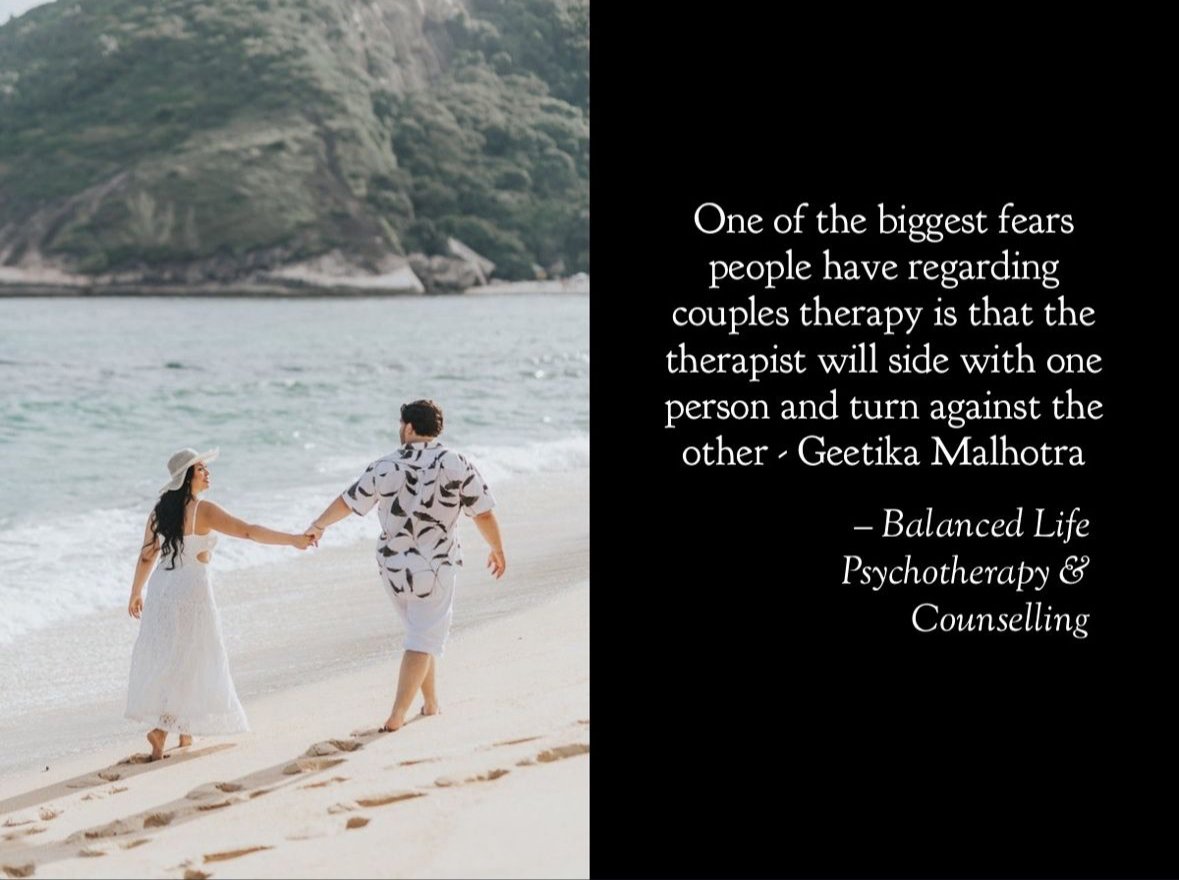
How to Convince Your Partner to Try Couples Therapy
Start by working out what they are actually refusing. Most partners who say no to couples counselling are not rejecting the relationship — they are protecting themselves from a specific fear, usually that the therapist will take sides, or that agreeing means admitting the marriage has failed. Name that fear, ask for something small and finite rather than open-ended, take the admin off their plate, and leave them a genuine way to say no. Pressure almost always produces a firmer no.
You have been thinking about this for a while. Perhaps you have already looked up therapists. And then you raise it, and your partner refuses — and the refusal feels like a verdict on the whole relationship.
It usually isn't. This resistance is extremely common, and it is nearly always fear rather than indifference.
What they are actually saying no to
Before you raise it again, it is worth working out which fear you are dealing with. In my experience it is almost always one of four, and people rarely say any of them out loud.
"The therapist will side with you and tell me everything is my fault."
"It's going to be a stressful fight every week, and I hate conflict."
"It's embarrassing to admit to a stranger that we're struggling."
"Counselling means we're broken, and the next step is divorce."
Each of these needs a different answer. A general "it'll be good for us" answers none of them, which is why it so rarely works.
Pick the moment properly
Tone, timing and language do most of the work here.
Avoid raising it during an argument, right before bed, or while the television is on. All three guarantee a defensive answer, and a no given under those conditions is harder to revisit later.
Choose a time when you are both relaxed, reasonably well-fed, and unlikely to be interrupted. A walk, a coffee, a Sunday afternoon.
Start with connection. Say something you genuinely appreciate about your partner before you move to the difficult subject. Not as a technique — as a reminder to both of you of what the conversation is in service of.
Change what you are asking for
The single most important shift is from what is wrong with you to what is wrong with how we talk to each other.
Instead of: "We need counselling because you never listen to me."
Try: "I feel like we keep getting stuck in the same arguments, and I want us to learn how to break that cycle."
The first is a charge, and invites a defence. The second describes a shared problem, and invites company in solving it.
It also helps to be explicit that you are going in to look at your own contribution, not to have your partner corrected. Saying that you want to understand what you are bringing to the pattern — and mean it — changes the proposition entirely. Most people will refuse an invitation to be assessed. Far fewer will refuse an invitation to be joined.
Answer the fear directly
Once you know which fear you are dealing with, you can address it specifically.
If they fear being blamed: "The counsellor isn't there to pick sides or blame you. Their job is to understand both of our perspectives and teach us new ways to talk." It helps to know this is structurally true rather than a reassurance — in couples work the relationship is the client, not either person in it.
If they fear an open-ended commitment: propose a finite trial. "Let's commit to three sessions. If after those three we both feel it isn't helpful, we won't continue. But we owe it to ourselves to at least try." Three sessions is a small, specific, bounded ask. "Therapy" is not.
If the obstacle is effort or embarrassment: take it off them entirely. "I've already found a few therapists I think we'd get on with, and I'll handle all the booking and logistics. All you have to do is show up."
You can also offer a lower-stakes on-ramp. Share the therapist's details and let your partner do their own research. Most therapists, including us, are happy to take a short call beforehand so a hesitant partner can ask questions and get a sense of the person before committing to anything. Being able to ask "what actually happens in a session?" of the person who will be running it removes a surprising amount of fear.
Leave them a real way to say no
Be invitational rather than demanding. Give your partner a genuine option to decline — and mean it. Counter-intuitive as it sounds, a partner whose autonomy is respected very often comes back with a yes some weeks later. A partner who feels cornered digs in, and the refusal hardens into a position they then have to defend.
An ultimatum may get someone into the room. It rarely gets them into the work.
"Doesn't asking for help mean something is seriously wrong?"
A client asked me this recently, and it is worth answering plainly: no, it does not have to mean that.
The best time to come is when things have started to feel uncomfortable and you do not quite know how to navigate them without escalating. At that stage you are both more open to change, more willing to course-correct, and carrying considerably less baggage.
Left alone, negative patterns become entrenched. The damage spreads — into how you parent, how you sleep, how you are at work — and becomes harder and slower to undo.
The couples who get the most from therapy are rarely those in the deepest trouble. They are the ones who came while there was still warmth to work with, and who usually leave in a better and stronger place than where they started. They treat it as maintenance — closer to a dental check-up than to A&E. Every relationship deserves that kind of attention from time to time.
And there is something worth saying to your partner directly: by suggesting this, you are showing that you are willing to fight for the relationship rather than in it. For a lot of reluctant partners, seeing that is exactly what tips the balance.
Frequently asked questions
What if my partner absolutely refuses couples therapy? You can start on your own. Individual therapy focused on the relationship is genuinely useful — you work on your own contribution to the pattern, and reluctant partners quite often join later once they can see it isn't an ambush.
How do I ask without it turning into an argument? Choose a calm moment, lead with appreciation, describe the pattern rather than your partner's behaviour, and ask for something small and specific rather than open-ended.
Will the therapist take my partner's side, or mine? Neither. In couples work the relationship is the client. The aim is to understand the cycle you are both in, not to establish who is at fault.
Can we just try a few sessions? Yes, and it is a sensible way in. Many couples begin with a small number of sessions and decide together whether to continue. Some prefer to start with a short introductory session online before committing at all. Check out our couples counselling options and our broader services/fees here. You can contact our admin team to book an introductory session via this link.
Geetika Malhotra is Director and Principal Psychotherapist at Balanced Life Psychotherapy & Counselling in Singapore. She holds an MA in Advanced Counselling and a postgraduate certificate in psychotherapy, and is certified in the Gottman Method and EMDR. She has practised for over eleven years with individuals, couples and families in Singapore and internationally.