What to Say When an Employee Tells You They're Struggling
It's 9:15 on a Tuesday. A high-performing member of your team comes into your office, or joins a private call, pales, and says: "I'm really struggling. I don't think I can do this any more."
In that moment you are not a supervisor. You are the first line of defence — and most managers I meet are terrified of it. They are convinced that one wrong sentence will make things worse.
The good news - your job as a manager is not to FIX anything. It is to be a safe bridge to professional support, and to get there within a day. That means three things: thank them for telling you, find out what they need in the next 24 hours rather than in general, and put a specific support pathway and a specific follow-up time in front of them before the conversation ends. You do not need clinical training to do this well. You need a process.
The capability gap
Organisations have invested heavily in mental health infrastructure: apps, platforms, employee assistance programmes. What most have not invested in is the people who actually receive the disclosures. Managers are left standing on a glass floor, holding a benefits manual they have never read, hoping the conversation doesn't come to them.
The mandate has shifted. A capable manager today is not simply someone who hits their numbers. They are, in effect, a psychosocial risk manager — which does not mean they are a therapist. It means they can do three specific things: recognise early and subtle signs of distress, respond with empathy, and activate a support pathway inside a critical 24 hour window.
Why 24 hours? Because in a fast, AI-reshaped working environment, a disclosure that isn't met with a clear route to help within a day tends to end one of two ways — quiet cracking, where someone stays but disengages, or an abrupt resignation. The window is not about urgency for its own sake. It is about the difference between a person feeling heard and a person feeling handled.
Before the conversation
Most managers are looking for the wrong signal. They are watching for someone who seems visibly upset, which is why they miss almost everyone.
Look for changes from that person's own baseline instead. Has your most punctual team member started logging on late? Has your most collaborative one stopped turning their camera on? Has someone easy-going become uncharacteristically irritable?
When you notice a shift, name it specifically and kindly rather than asking a general "how are you?" that invites a general "fine":
"I've noticed you've been a bit quieter in meetings lately, and I just wanted to check in and see if you agree & also how you're doing."
The conversation itself
When someone does disclose, the instinct is to move straight into problem-solving. Resist it. What follows is the shape of a conversation that works, with the specific language for each stage.
1. The opening — validate, don't analyse
The goal is to acknowledge the courage it took to speak, without immediately trying to diagnose the cause.
Say: "Thank you for being open with me. I know it isn't always easy to bring this up, but I'm glad you did. Your wellbeing is much more important than any project we have on the board right now."
Avoid: "I know how you feel, I'm stressed too." This shifts the conversation to you and minimises their experience. Also avoid "Is this because of the Project X deadline?" — which reduces something personal to a task management problem, and quietly signals that you'd prefer it to be one.
2. The discovery
The goal is to understand their immediate capacity, while staying firmly inside your role as a manager.
Say: "I want to make sure you have what you need today. On a scale of one to ten, how overwhelmed are you feeling right now? And is there anything on your plate for the next twenty-four hours that we can move or reassign immediately to give you some breathing room?"
Avoid: asking for a diagnosis, or for details about their home life. You are not assessing them clinically and you should not try. Keep the questions on capacity and on how they are feeling — both of which are legitimately your business, and neither of which requires them to disclose anything private.
Through this stage, the useful discipline is A.L.E.C.:
Ask — open questions. "How long have you been feeling this way?"
Listen — full attention, no multitasking, no email.
Encourage — make it explicit that speaking up was the right call.
Check in — agree a specific time to follow up.
3. The activation — move from talk to action
The goal is a concrete next step before the conversation ends.
Say: "My priority is getting you the right support. Here is the number for our employee assistance programme — I'm going to send it to your email now. I'd also like us to check in again tomorrow at eleven, just to see whether you were able to connect with someone, or whether you need help navigating it."
Avoid: "Take some time and let me know when you feel better." It sounds generous and it is the single most common failure in these conversations. It leaves the person adrift, with no next step, and quietly transfers the entire burden back onto someone who has just told you they are struggling to carry it.
You do not need to know your organisation's fifty-page benefits manual. You need to know the one number or link that triggers professional help, and to have it somewhere you can find it in ten seconds. Your job is to be the bridge, not the destination.
The two fears that stop managers having this conversation
Almost every manager I work with is held back by one of two worries, and both deserve a straight answer.
"I'll say the wrong thing and make it worse." Far more damage is done by saying nothing. A clumsy, well-intentioned check-in followed by a real support pathway is a good outcome. Silence from someone who has noticed you are struggling is not neutral — it reads as indifference.
"I'll become a dumping ground." This is a legitimate concern and it is why so many managers avoid opening the door at all. The answer is not distance; it is a clear boundary. You are not providing the support, you are connecting someone to it. Naming that out loud — "I'm not the right person to help you work through this, but I am the right person to make sure you reach someone who can" — is both honest and kind.
For HR leaders
If you run people functions, the shift worth making is from awareness training to competence training. Managers do not need another module explaining that mental health matters. They need to know what to say on a Tuesday morning.
Give them scripts. A two-page cheat sheet with word-for-word language for handling a disclosure. Managers are frightened of causing a crisis, legal or emotional. Remove the guesswork.
Formalise a 24 hour response protocol. Any manager who receives a disclosure should have a route to advice on the next step, immediately.
Set up shadow support. Give every manager a named, confidential contact they can message the moment a disclosure lands: "Someone on my team has just told me they're struggling. I've given them the EAP details. What's the next step to protect their privacy and keep the work moving?" This single mechanism does more than any training module, because it means no manager is ever improvising alone — or feeling, as many describe it, that they are practising therapy without a licence.
Normalise boundary-setting. Train managers to be supportive while remaining managers. Most avoidance in this area is not indifference; it is a reasonable fear of being pulled into a role they are not equipped for.
The bottom line
As AI reshapes how work gets done, an organisation's advantage is not only its technology. It is the psychological resilience of its teams — and that resilience is built or broken in small, private conversations between one manager and one employee.
Closing the capability gap is not a nice-to-have. It is one of the more effective risk management decisions available to you.
Frequently asked questions
What should a manager say when an employee discloses burnout? Thank them for telling you, ask what can be moved or reassigned in the next twenty-four hours, share the specific support pathway available, and agree a follow-up time before the conversation ends. Avoid diagnosing, and avoid "let me know when you feel better".
Is a manager allowed to ask about someone's mental health? You can ask about capacity, workload and how someone is feeling — that is squarely within a manager's role. You should not ask for a diagnosis, medical details or information about their home life.
What if the employee doesn't want to use the EAP? Offer it without pressure and leave the route open. You can also ask what would make support easier to access — for some people it is confidentiality, for others a therapist outside the company entirely.
How do I train my managers to handle this? Short, practical sessions built around scripts and real scenarios work considerably better than awareness modules. Our practice runs this as a workshop for teams in Singapore and online. Click here for our corporate wellness solutions.
Geetika Malhotra is Director and Principal Psychotherapist at Balanced Life Psychotherapy & Counselling in Singapore. She works with organisations on workplace mental health, manager capability and employee assistance provision, and with individuals, couples and families in private practice.
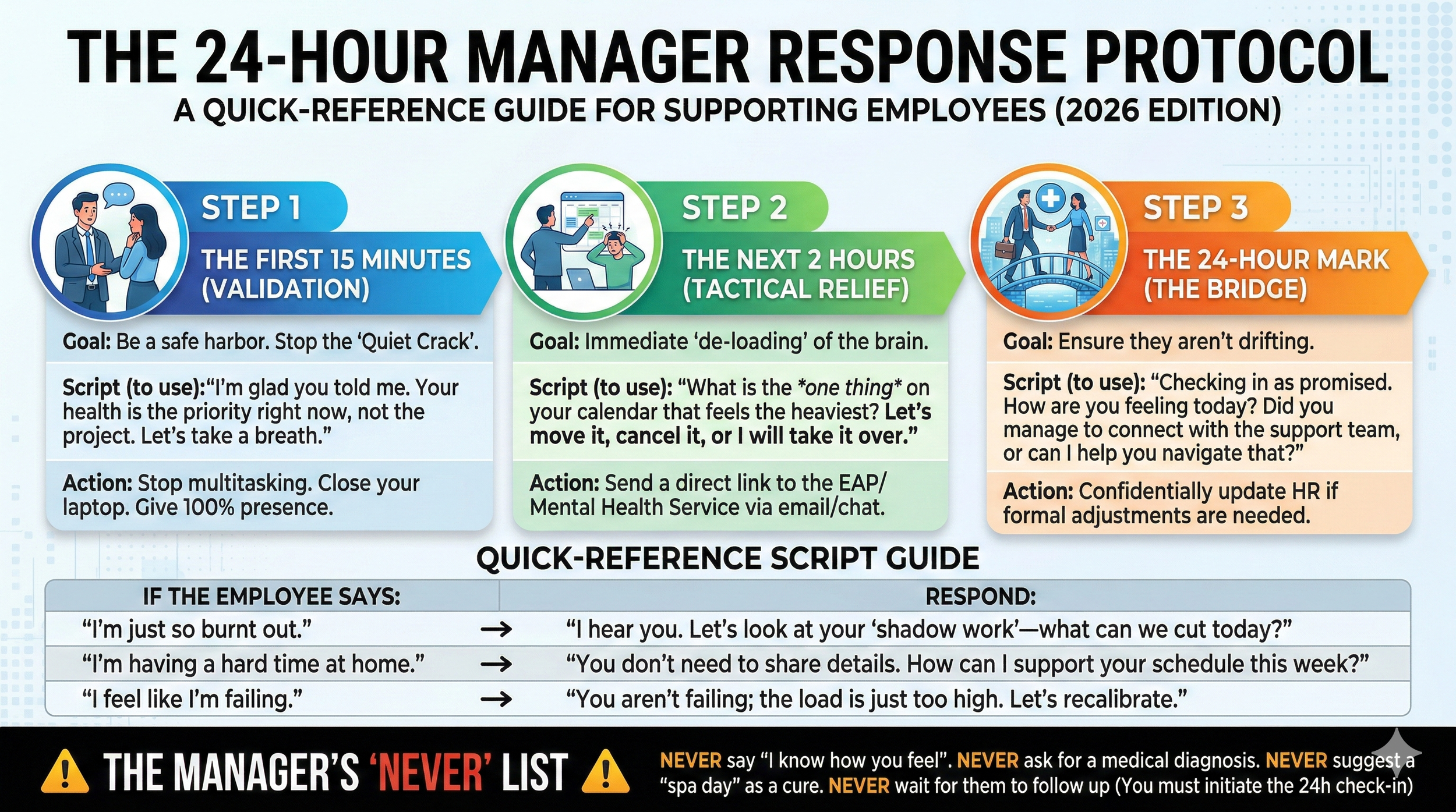
a 3 step guide for supporting employees going through emotional distress